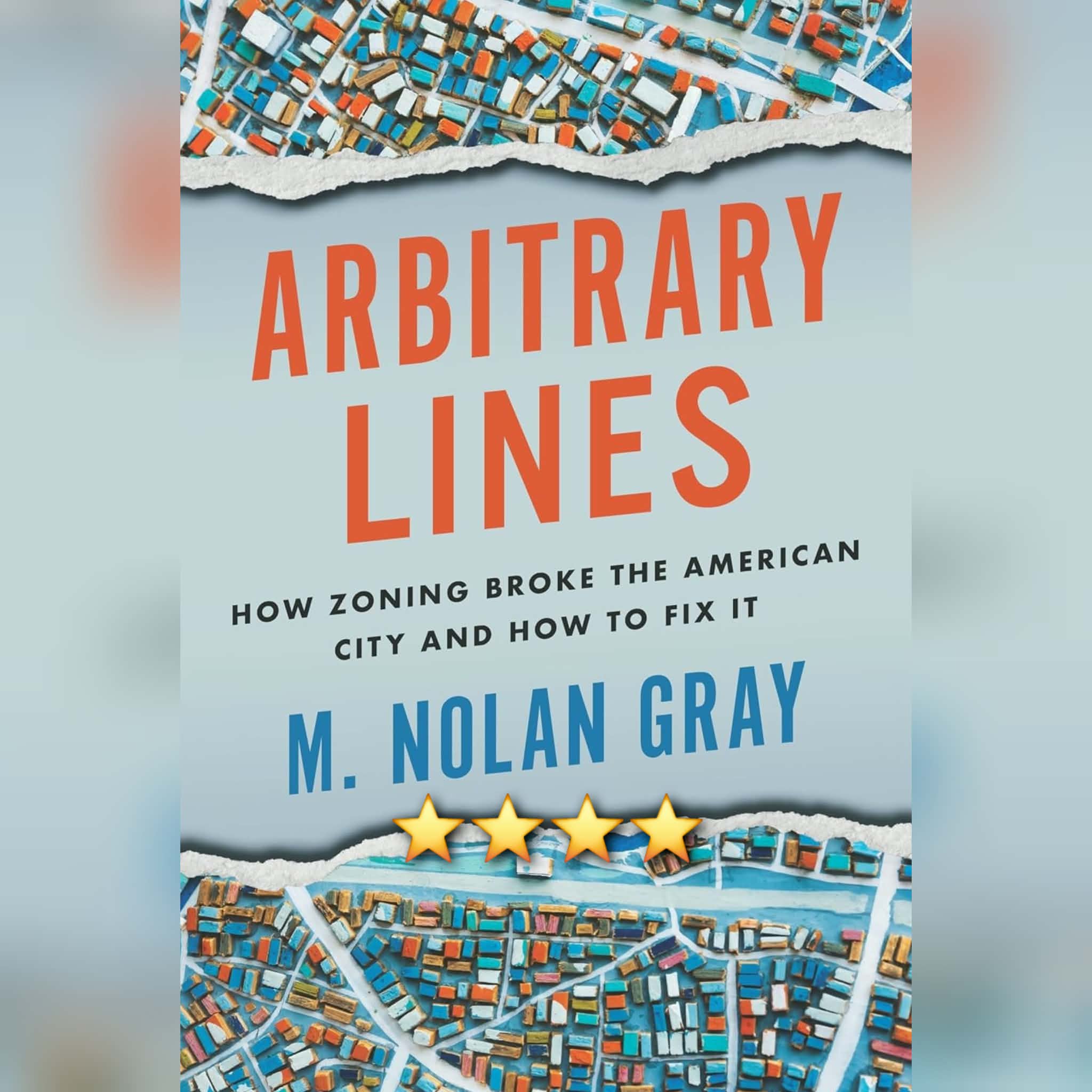
Book Review: Arbitrary Lines by M. Nolan Gray
More Comprehensive Than Some Yet Still Misses Key Elements. I read this book on my morning walks immediately following finishing Paved Paradise by Henry Grabar (about mandatory parking requirements in the US and featuring heavy discussions of some things and even sources that Gray discusses more briefly here), and I'll be following this book with Killed By A Traffic Engineer by Wes Marshall. Clearly, I have a theme going right now.
Where Grabar focused *exclusively* on parking - and suffered for it -, Gray writes a mostly more comprehensive - yet still quite dogmatic - view of another piece of the puzzle: zoning, what it is - and what it isn't. Whereas Grabar is much more polemic with his text, Gray here has a clear perspective... but he's also a *lot* more balanced in it, actively discussing elements that will pull in and repel different elements of most any political persuasion - even if his own is quite obviously in the realm of democratic socialism moreso than true property rights respecting liberty.
Essentially, Gray believes that cities *should* be planned at some high level, but that market forces should be allowed to play out within that overall structure. Effectively the current Chinese Communist Party model - and, to be fair, a large cross section of the current American model. Hell, Gray here actively advocates for eliminating *some* of the more onerous controls... while still allowing many of them to exist in other forms he deems more appropriate. Such as "Community Land Trusts", where a nonprofit buys up a set of land then effectively sharecrops it out, retaining ownership of the land while allowing houses to be bought at an "affordable" rate on that land... so long as they then keep the price "affordable" when that house is later sold. Due to appreciation and inflation, this means that buying into such a property negates one purpose of buying a home - to appreciate wealth when it is later sold. Which, to be fair, is a purpose Gray actively advocates against to begin with, so he is at least consistent in this approach. But this also means that those on the lower end of the socio-economic spectrum who need such affordable homes to begin with will be *trapped* in such affordable homes via not being able to sell them at true market rates later and potentially use that profit to move up the socio-economic scale. Herein lies the crux of one of the main problems of this text, and I deduct roughly half a star for this obvious gap in logic.
The other half a star comes from missing out on certain key elements that prevent the utopia Gray wants here. Specifically, Gray repeatedly advocates for a far more uniform mix of the lowest rungs of the socio-economic ladder and the highest rungs in and near the exact same lands - a truly utopic vision. Because what *actually* happens in such blends is that crime rates skyrocket, as those with nothing left to lose - those for whom prison life would be an improvement on their current living situation - have more ample opportunity to commit the very crimes that would get them sent to prison. Similarly, in advocating for more density and more mass transit, Gray also ignores the higher prevalence of mass transit related crimes - everything from the 70%+ of DC metro riders skipping the fare (according to a recently published study in August 2026, four years after the publication of this book, to be fair) to the (brazen murder of a light rail rider in Charlotte in August 2025, also three years after the publication of this book), among other crimes both lesser and greater associated with mass transit.
*So far as it goes*, this book truly is reasonably well balanced, if from a very specific overall perspective, though Gray does indeed go through pains to stress that this is all a conversation, that he may in fact not have all of the answers - and it is this more reasoned and reflective approach even while holding strong personal beliefs that actually serves to enhance the overall nature of the text itself.
Once again, because this was an Audible read while walking, I don't have access to any bibliography data, so I can't comment on that either direction here.
But as it stands and with my own experience with this text and given my own background as a 2x former City Council candidate and political blogger who has lived and worked in areas both rural (southern Georgia, near Albany) and urban (Atlanta, Jacksonville) and actively campaigned on planning and zoning issues (a sign ordinance in Luke Bryan's hometown that ultimately hindered a local barber enough that he was forced to close shop), I really do think that this book is a pretty strong look at the issue of zoning overall, both what it is - and isn't - and how it has both shaped America as we currently experienced it and some ways Gray thinks we may be able to move forward without it. Ways that are reasoned enough from his perspective that they truly deserve an equally thought out and reasoned response at a more societal level, and this book at least exposes a lot of the issues that should be considered there.
Very much recommended.
This review of Arbitrary Lines by M. Nolan Gray was originally written on August 21, 2026.