Yes, Christians Should Read Horror Books Too
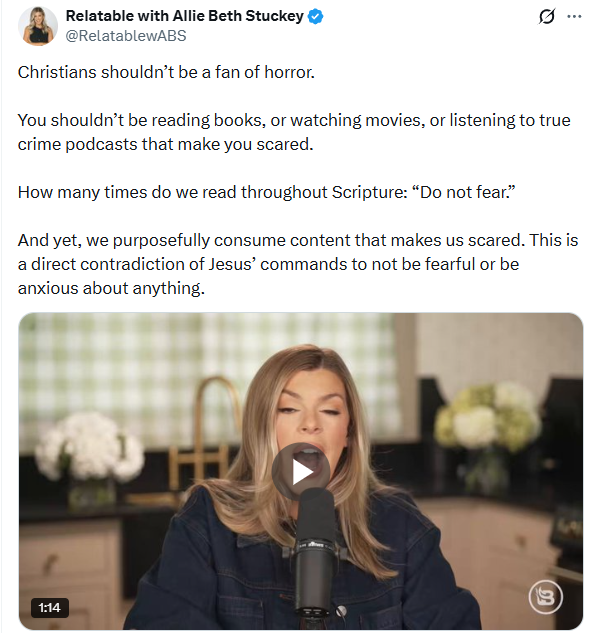
Current drama on Twitter/X involves a podcaster whose most recent book was so bad that even though I read it trying to defend it, even I ultimately proclaimed it “Not recommended for anyone but the truly masochistic” now proclaiming that Christians should not “be fans of horror”.
Now, I was raised in the Church. My earliest memories are of going to a Church of God church, one where my high school mentor and the man who changed my life later went on to be the Principal of the school it ran for several years after his retirement from public education. I spent my later single digit years and teens in a Southern Baptist Church and during this period, my pastor of many of these years was a man who later (after I left that church) became President of the Georgia Baptist Convention. I then spent a few years - including when Hurricane Katrina struck the Gulf Coast in 2005 - at the very Independent Baptist church that my parents had gotten married in 25 years earlier.
Some of my earliest chapter books - not the earliest, but also within just a couple of years or so of reading chapter books at all - were stuff like Josh McDowell’s Powerlink Chronicles… and Frank Peretti’s works, including his most famous works (at least in the circles I ran in at this point in my life) This Present Darkness and Piercing The Darkness, all from the church library of the church that was later ran by the eventual GBC President. (He wasn’t there yet at that point though, and if I remember right the church library was ended either before he got there or shortly after - but we’re talking 30 ish year old memories here. ;) )
Peretti, for those unfamiliar with his works, is essentially a Christian Stephen King. Ultimately very similar in overall style, enough that fans of King who don’t mind Christian messaging should try his books if you haven’t yet. But also quite heavy in his Christian messaging and preaching. These are books written specifically in their era for his community of that era, and I haven’t read them in over 20 years now to see any idea of how I would rate them under my current thinking.
But, like King, they are straight horror books. Evil is dark and foreboding and an active, real threat. Even when we step out of supernatural books like TPD/ PTD and look to books like The Prophet, where a journalist becomes an anti-abortion crusader and the evil is far more human in nature, it is still just as dark and foreboding and still very much a very real threat.
Peretti was also one of the most popular and prolific authors within Christian fiction in that era. When grocery stores still had a book section near the checkout, as they did into at least the mid 2000s, Peretti was one of the authors you could fairly reliably find if it had a religious books section at all, alongside the ubiquitous Max Lucado or Joel Osteen or TD Jakes books.
Peretti even inspired at least one other author who wrote, so far as I am aware, exactly two fiction books in the style of TPD/ PTD before switching over to nonfiction books based on original research she was doing - Shaunti Feldhahn and specifically her The Veritas Conflict (and later The Lights of 10th Street). Veritas is one of the books I frequently name as foundational to me, as it contains a scene that really brought home just how essential God views Free Will, and that realization ultimately changed quite a bit about how I view almost literally everything.
Then there’s Ted Dekker. I haven’t read as much of his stuff, but what I’ve read is quite inventive… and one of the strongest (and most explicit) Biblical allegories I’ve ever read. Yet it is also quite horrific, and the evil is again dark, foreboding, and very real and a very real threat. Here I speak specifically of his Circle Series - a quadrilogy where when a man falls asleep in our world while trying to prevent a major terrorist attack somehow tied to himself, he awakes in another world that is a full Biblical allegory. Similarly, when he falls asleep there, he awakes back in our world - and the events and fates of both worlds are tied together.
Some of Dekker’s other stuff, both before and since, is again quite similar to King in its utter horror… again with pretty blatant and in your face Christian messaging. But again, the main Circle books are really the only thing I’ve actually read from Dekker, despite having many of his books in my library, and even this was now nearly 20 years ago.
Dekker then got me ready for a man you’ve heard about a lot if you’ve been following me for nearly any amount of time, a man I’ll see IRL once again in just a couple of weeks - Jeremy Robinson.
Robinson has a lot of books out now (maybe even more than Dekker himself?), and many (particularly in the early era of his writing career) are Biblical allegories but such that you only get the allegory if you’re already fairly familiar with both the Bible and Christian teaching of various forms. For anyone else, even Robinson’s most blatant allegories (THE DIDYMUS CONTINGENCY and KRONOS, both of which are directly based on different stories directly from the Bible) are simply kick ass scifi action tales. Which is why I love him so much - because he cares enough to create a solid story, while also (at times) burying a Christian message within it. Other books within this general realm from him include UNITY (wherein various single color forms of a tattoo play a role in the tale… and I eventually got the combined tattoo - that plays a role in the tale’s endgame - actually tattooed on my own arm due to the strength of this story), APOCALYPSE MACHINE, THE DIVIDE, THE LAST HUNTER (wherein its hero is modeled after Robinson’s own son), FORBIDDEN ISLAND (where the cover was changed in part because I knew exactly what the allegory was two seconds after seeing the original cover) and two I specifically want to discuss here: TORMENT and THE DARK.
You see, TORMENT is quite the interesting book. For those unfamiliar with the Bible, this is just a near-future high tech zombie horror tale. For these readers, the ending can be a bit… open. But for those more familiar with the Bible and specifically conservative (particularly American Evangelical) teachings about it over the centuries… TORMENT is a 2010s era retelling of Jonathan Edwards’ SINNERS IN THE HANDS OF AN ANGRY GOD, y’all. (Which was itself a 17th century retelling of Dante’s INFERNO… which is something that was never once mentioned in my K12 education when we studied Edwards’ sermon as the classic American literature it is. Go figure. Can’t imagine how little kids today are told about this, if they are even required to study it at all anymore.)
THE DARK takes a long standing Catholic teaching (also based on elements of Norse mythology) and at one point has a scene even more utterly horrific than that Mass Effect 2 scene… but ultimately is yet another Christian allegory, if buried a bit and less obvious than most even for Robinson’s books.
All of which is a very long way to get to my ultimate point:
Hell is quite real. Hell is utterly horrific, even if you don’t view it with the traditional hellfire/ brimstone/ pointy tailed dude with a pitchfork. Even its actual Biblical description as a place of total separation from God is truly utterly horrific in and of itself, without any human invention of what that might look like.
The horrors of Hell are also something that particularly American Churchians really don't actually speak of or preach of much anymore, particularly not in the ways our forebears like the aforementioned Edwards or the Mathers (colonial era influential preachers Increase and his son Cotton, not the more recent Marshall) or even more recently the late great Adrian Rogers and W.A. Criswell did so very often. It isn't "seeker friendly". It is "judgemental". It is "scary". YES, IT IS FUCKING SCARY!!! PERMANENT AND FOREVER SEPARATION FROM THE HOLY GOD IS THE SINGULAR MOST TERRIFYING THING ANY HUMAN CAN EVER POSSIBLY EXPERIENCE!!! THIS IS WHY JESUS WAS ON THAT CROSS TO GIVE US A WAY TO AVOID IT, CHRISTIAN! AND WE HAVE A DUTY TO TELL THE WORLD ABOUT JUST HOW HORRIBLE IT IS! But that doesn't mean we have to proclaim people condemned to it ourselves. Peoples' decisions about God are entirely their own. Our job is to tell them about it and respect them - and God - enough to allow them to make up their own minds about it, whatever that may be.
Christian Horror - including the books I detailed above and so many more, both from these authors and many, many more - can bring this to life for readers in ways that the Bible and Christian Doctrine simply can’t. It isn’t the purpose of the Bible or the Doctrines, and even if it were, there is only so much a book compiled millennia ago can do for modern readers, even those actively interested in studying it. Hell, I had been reading the Gospels for years before the "crucifixion" scene in Bill Myers' ELI (wherein the central idea is "What if Jesus had been borh in 1970s Santa Monica?") made it REALLY hit home in ways not even the Apostle John - who had seen it with his own eyes! - could do for me. (ELI is more straight scifi than anything actual horror.)
It can also be a bridge to those who would never knowingly and willingly be on the same continent as a Bible to expose them to its ideas - and the best uses of this are when the story is not so in-your-face preachy about being a “Christian Fiction” book but instead focuses on telling a great story first, then working in the Christian allegory in service to the story itself. (Gee, wonder why I’m such a fan of Robinson? ;) )
In fact, I know of a few of Robinson’s fans who actively proclaim themselves as about as anti-Christian as anyone can possibly be… and in a few cases some of the very books I’ve named here are among their favorites of his books. And this is just one example of something I’ve been around nearly as long as I’ve been with my wife. (Hard to believe this coming January will be 20 years since we met! Robinson and I met around this time, in MySpace.)
Oh yeah, and there’s that bit about Christian Horror being a thing almost since Christianity itself has been. Even the Book of Revelation is, effectively, horror. ;)
Now, Stuckey has her defenders. That’s fair. They can be wrong all they want. I know quite a few Christians across most every strand of Christian-esque thinking out there that I will stand equally against on different points at different times, but this one directly impacts culture and specifically reading, and, well, that’s generally what I actually write about these days.
So what do you think? Am I completely off base here? Are there any other Christian-based horror writers you think I should add to the thousands of books in my backlog? Any I should drop everything and read now?