
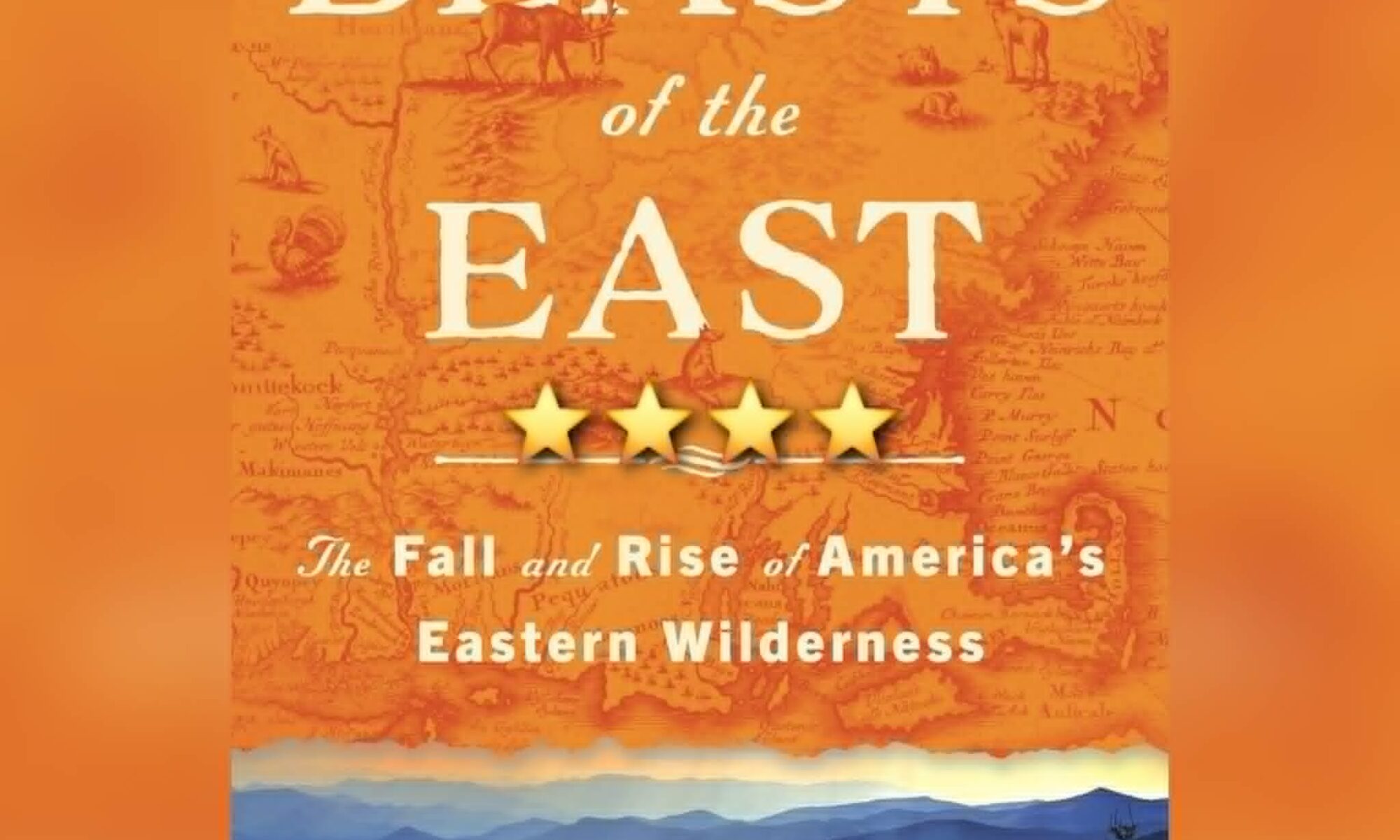
#BookReview: The Beasts Of The East by Andrew Moore

Interesting History Marred By Substandard Bibliography. This text essentially takes Cat Tale by Craig Pittman and does for elk, buffalo, and red wolves what Pittman did for the Florida panther – explain the historic ecology of the animal, how humans nearly wiped it out, and what humans are doing to try to restore it. And yes, even without directly naming Pittman in the text, the story of the Florida panther is at least briefly mentioned here, specifically as it relates to similar issues and interventions with the red wolves.

Along the way, we’re going to meet a *lot* of humans and see their roles in the fall and rise of these species, and we’re going to get a *lot* of discussion of both plant and animal ecology… and how the two different types of scientists and activists are often at odds, or at bare minimum rarely talk in the same “languages”. We’re going to see historic figures both known and not, including some in both areas who have had significant impacts on these creatures in various ways.

All of this is done in a professional journalist tone, but with a clear (if relatively mild) bent to a particular worldview common among professional journalists and scientists. Which will be annoying to some readers, but should only rise to the level of seeking the nearest window for defenestration purposes among the most extremely against this view. Point being, this isn’t a book where the author is going to inject humor or levity really at all – this simply doesn’t appear to be this author’s style, and the style he chooses to use here ultimately works to be informative without being sleep inducing, which can be a very fine line to toe at times.

Really the only actual fault here was the dearth of a bibliography, listing a “selected” bibliography of just 10% of the Advance Review Copy version of the book I read a week before publication (despite having it for several weeks before that), when a bare minimum of 15% – and more typically, particularly for books of this type, 20-30% – documentation is more standard.

Ultimately, the fate of this book will actually have a lot in common with the animals it details: Getting people to actually care about these animals will ultimately determine both their fate and the fate of this book, and indeed one would expect that both sides would help each other in common marketing here. But as a general guide from someone outside of that particular group, I would say that if you’re interested in the history of ecology and the natural North American biome, both in what it was and in how humans have been shaping it these last few hundred years in particular, this is absolutely going to be a book you’ll find interesting. If you’re looking to learn about these issues at all, this will be a solid overview of everything that has transpired through late 2024 or so. And if you’re just looking for a decent doorstop, well, at 400+ pages, eh, this could work in a pinch there too. 😉

Very much recommended.

This review of The Beasts Of The East by Andrew Moore was originally written on May 27, 2026.

#BookReview: Sea Of Grass by Dave Hage and Josephine Marcotty

Seemingly Comprehensive Review Of Its Field Marred By Dearth Of Bibliography. This is one of those books you pick up randomly because “hey, I don’t actually know more than the very rough basics about the American Prairie”, and it will actually give you a largely well rounded view of the entire topic, from its ancient origins and pre-European development through the Indian Wars/ Manifest Destiny era and through the Dust Bowl years all the way up to mostly current farming tech/ practices in the region. Yes, the commentary is titled perhaps a touch toward the left side of the dial, but honestly it wasn’t anywhere near as pervasive or preachy as some other similar texts tend to get, so eh, it was enough to mention here but now I’m moving on.

No, the real problem, at least with the Advance Review Copy edition I read roughly 6 months before publication, is the dearth of a bibliography, clocking in at just 7% of the overall text – a far cry from even the 15% of my newly relaxing standard for bibliography length, much less the 20-30% of my former standard. So that’s the star deduction – for all of the facts presented, there simply isn’t anywhere near enough bibliography to back them up – much less the more editorial commentary.

Overall a seemingly strong primer on the topic, I know I learned a lot about a lot here, and I suspect many will as well. I simply wish it had been better documented.

Very much recommended.

This review of Sea Of Grass by Dave Hage and Josephine Marcotty was originally written on December 3, 2024.

#BookReview: Ignition by M.R. O’Connor

Controversial Yet Mostly Solid – But Needs Better Documentation. I first became interested in fire management over a decade ago, when I read an article on wired.com on July 8, 2012, where it made the case that perhaps our modern American efforts to suppress wildfires… had actually led directly to fires becoming ever bigger and more destructive. Over the following 11 yrs, I would both watch the movie Only The Brave, about the Yarnell Hill fire that claimed so many firefighters’ lives less than a year after that Wired article came out (which I just realized when researching for this review) and read the book Granite Mountain/ My Lost Brothers (it has used both titles) by Brendan McDonough that the movie was based on. I had also already seen numerous controlled/ prescribed burns as a native of the Southern US, and distinctly remember several over the years in the woods directly behind Lee County (GA) High School – where country singer Luke Bryan, American Idol Season 11 winner Phillip Phillips, and San Francisco Giants great Buster Posey had all attended.

All of that to say that here, O’Connor spends a year actively working with wildland firefighter crews roaming the western US (well, west of the Mississippi – she starts and ends in Nebraska), learning their ways, their thoughts, their struggles. And creating a compelling voice for her effort in this book. She gets the same certifications they do, goes through the same training and meetings, and does everything she is qualified to do per those trainings, and in turn we as readers get a first hand account of what it is really like on said crews. (Which McDonough’s book is also great at – just be prepared for some *very* dusty rooms near the end of that tale.)

Through this memoir portion of the book – interwoven with other interviews and research that I’ll get to momentarily – she is particularly strong and vivid. Truly, read the book for these passages if for no other reason, as it really brings home what a difficult, demanding, and yes, frustrating job this can be.

Even the research, both interviews and historical, is truly remarkably well done. It is this section in particular (along with, perhaps, some of the commentary from the fire teams she is on) that will likely prove most controversial, as it really drives home the exact point that at least parts of that 2012 Wired article were making – the “suppression only” firefighting tactics we’ve used against wildfires primarily over only the last century or so really do seem to be causing more harm than they are doing good. And, as it turns out… pretty well everyone knew this before we started doing it. From millennia before Europeans came to the Americas, Native Americans had already been using fire to shape and control their environment in numerous ways, and had already developed tactics that worked *with* nature for the good of all beings. O’Connor’s work here makes a particularly strong case that at minimum, these strategies need to be more actively considered. Indeed, much the same way that Gilbert Gaul’s 2019 book The Geography Of Risk made such a strong case for re-examining coastal development strategies in the face of hurricane damage.

The one weakness here is a quibble, perhaps, but it is consistent with my other non-fiction reviews (and I did already mention it in the title of this review, above), and that is that at just 14% bibliography, it falls a bit short in my own experience – where 20-30% documentation seems to be more standard. Extraordinary claims – and yes, challenging the prevailing “wisdom” of the last century qualifies as such – require extraordinary evidence, and while O’Connor’s case through her narrative is stellar, her documentation is sadly quite lacking.

Still, overall truly a fascinating read that deserves far more attention than it may ultimately wind up getting. Very much recommended.

This review of Ignition by M.R. O’Connor was originally written on October 11, 2023.