
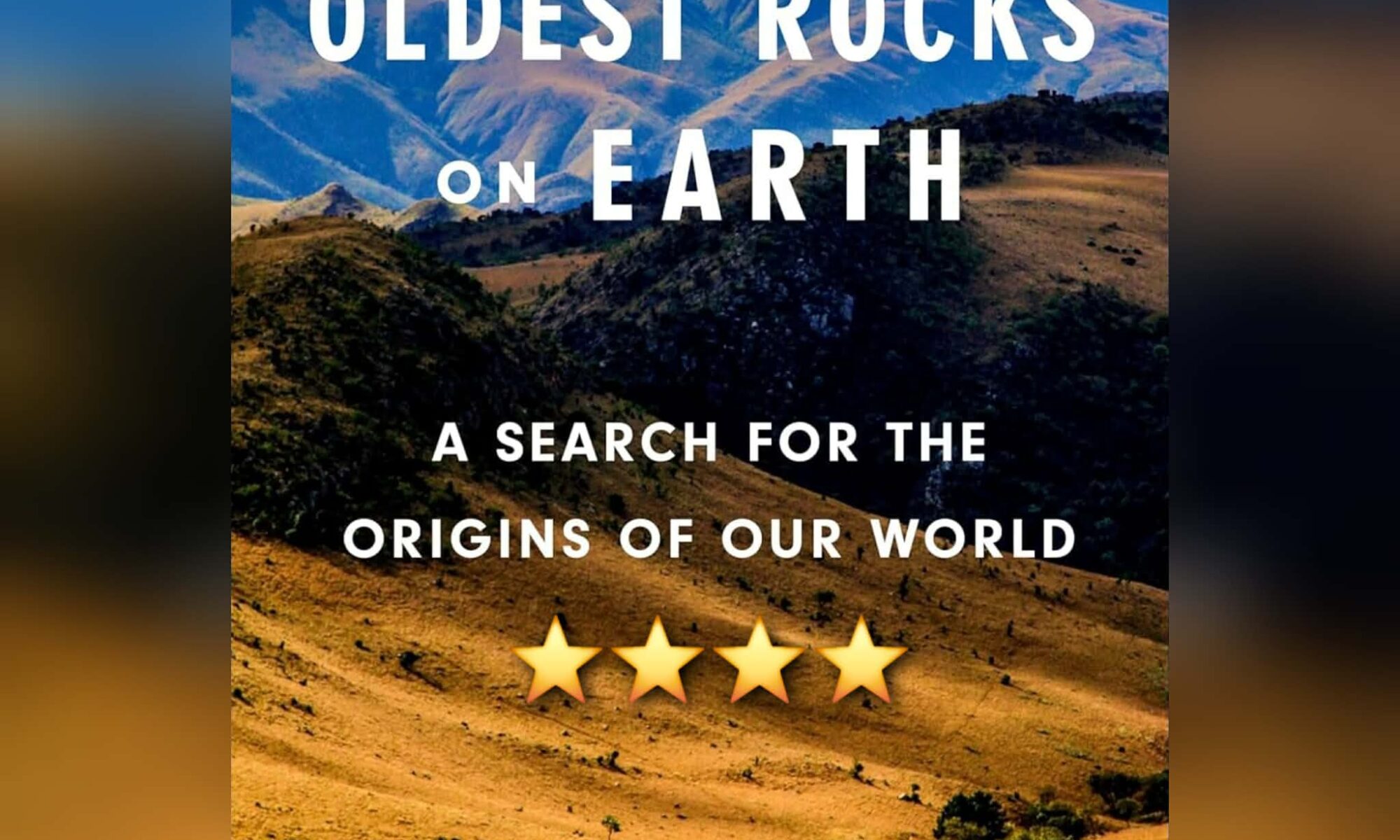
Part Geologic History. Part Memoir. All Intriguing Information. This is one of those books where, like at least one other early reviewer mentioned, it is nearly as much about the author as it is his subject. So for those looking for a book more solidly focused on geology or science, where the author rarely if ever interjects himself into the narrative… know up front that this isn’t that. At all.
Instead what we get is a book where the author has spent a lifetime researching something he is clearly passionate about, one where he has several personal theories he openly admits aren’t shared by all of those in his field, yet also one who has had some very interesting experiences along the way as he was doing his research. This narrative encompasses all of the above and more. We get a lot of deeply scientific detail of how the oldest rocks on Earth formed and how scientists find and study them. We get a lot of stories of the type of “and that is how I wound up being the personal taxi for an entire region when the regional bus failed one day” or “these are the people I was partying with at a remote campsite deep in the African wilderness”. We also get several instances of “these are my personal theories based on my own research and studying the field for a lifetime, but not everyone agrees with me”.
In other words, a fascinating look at a topic that some could consider quite dry indeed, but which Lamb brings to life with both his own life and his passion for the subject. Yes, there is perhaps too much here at times for anyone who knows anything less about this subject than Lamb himself does, but for the most part he really does explain even these concepts well enough that the reader can have at least a rough understanding of them – enough to generally follow along with Lamb’s narrative and story, if not enough to pass any kind of test about them.
No, the only real thing I could find to fault here is the dearth of a bibliography. Yes, I recognize that this tale is at least part memoir, but still, there is enough geology and objective nonfiction here that just 12% bibliography still seems lacking, even if much of the objective nonfiction is based on the author’s own research. But hey, maybe I’m being a touch harsh there. Read the book for yourself and write your own review of it and let the world know either way what you think on that point. 🙂
Overall a truly fascinating book that works as much as a travel memoir as it does as a geologic tale.
Very much recommended.
This review of The Oldest Rocks On Earth by Simon Lamb was originally written on December 18, 2025.