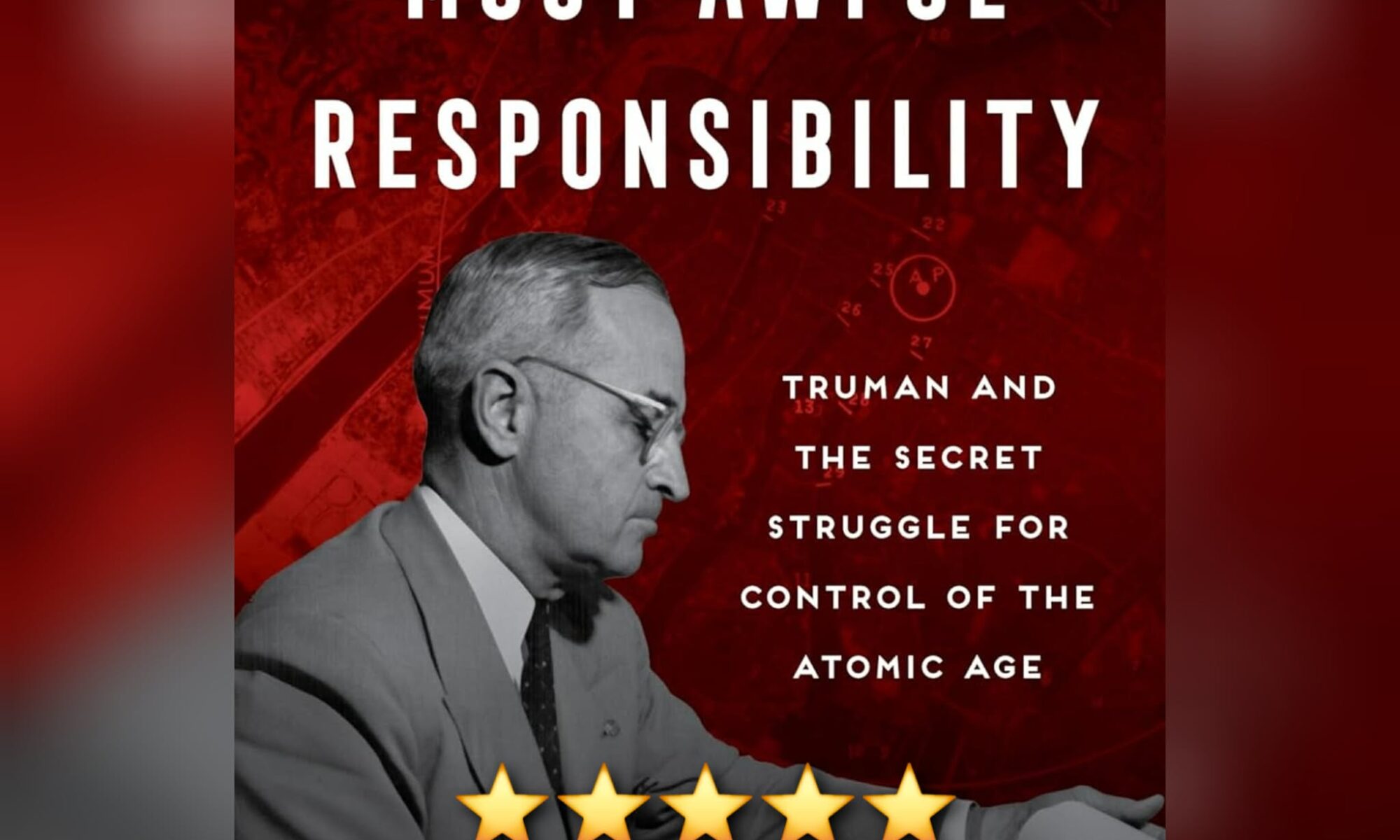
#BookReview: The Most Awful Responsibility by Alex Wellerstein

Reasonably Well Documented Book Will Force You To Rethink All You Think You Know Of The Post-WWII Era. This is one of those rare history books that actively goes in to not just point out something most people missed about an era and/ or a person, but also goes to show the reader that a lot of what you thought you knew… may not have happened quite the way you think it did.

For example, one of the main points of the early part of the text: You think President Truman ordered the dropping of the atomic bombs on Hiroshima and Nagasaki. That was what most textbooks (at least in America) teach, at least lower than say upperclassman history majors at the collegiate level. Except…. Wellerstein shows here – repeatedly – that this wasn’t exactly how that went down. Indeed, Wellerstein uses first hand sources from a few different key people – including Truman himself, where possible – to show that not only was there not one single decision to drop the bombs or where, but that Truman himself likely understood neither the weapon nor the target profile. (Which, let’s face it, both humanizes him a bit more – something Wellerstein is *great* at in this text, for what that’s worth – and should give most of us at least a touch of hope given more recent Presidents and their mental abilities.)

Then, in the period after the bombings, Truman – and the world – realize what has been done… and Truman is personally absolutely horrified. This is where and when the real struggles begin, and the “rest of the story” (as Paul Harvey famously proclaimed for so long) begins. And y’all, this part reads almost like a DC spy thriller/ court drama. High ranking people across several different realms within the US government all seeking to have their vision of the future made manifest, with Truman – and his famous “buck stops here” mantra – the focal point and the one both making decisions and seeking to establish his own preferred path.

Now, with all this lesser known history and with the entire point of the book showing a side of Truman most often ignored by history and historians, some may argue that this necessistates application of the Sagan Standard -that these are extraordinary claims that thus require extraordinary evidence. From my reading here and my understanding of both this text and the relevant histories as I know them, I don’t think this is true. This is a bit of a bombshell, yes, but is also fits pretty squarely in with known histories, it simply illuminates lesser known corners of those histories more properly. Thus, for me, the roughly 20% bibliography here sufficiently establishes a reasonable amount of documentation, and the frequent citations of the diaries and memoirs of those directly involved show the depth of research Wellerstein was able to bring to the table here.

Overall a very well written text that will completely rewrite your understanding of the post-WWII period as it relates to the use and control of atomic weapons – which seems to be Wellerstein’s very point, meaning he executed that point to near perfection.

Very much recommended.

This review of The Most Awful Responsibility by Alex Wellerstein was originally written on December 14, 2025.

#BookReview: The Hiroshima Men by Iain MacGregor

Among The More Complete Histories Of The Nuclear Bombing Of Japan. Clocking in at nearly 450 pages, with only about 10% of that bibliography – and hence the star deduction – this account really is one of the more complete accounts of the entire event I’ve yet come across in all my years both reading books generally and studying WWII in its various facets more specifically. It was also the last of three books about the bomb and/ or the use of it that I read over the few days of US Memorial Day Weekend 2025 or in the days immediately after, the other two being Evan Thomas’ 2023 book Road To Surrender and Frank Close’s June 2025 book Destroyer Of Worlds.

Specifically, in tracking exactly who it does – including several key US personnel involved with both war planning and the Manhattan Project itself, the pilot of the bomber that dropped the bomb on Hiroshima, the reporter who really opened America’s eyes to the horrors of nuclear fallout, and even the Mayor of Hiroshima himself – this book really does give a complete all around picture of all aspects of the creation and use of the atomic bomb and the repercussions for both American leadership and Japanese civilians.

Reading almost like a Tom Clancy or perhaps Robert Ludlum war thriller at times, this text *also* manages to have the emotional heavy hitting of Hersey’s original Hiroshima report, which it covers in nearly as much detail as Lesley MM Blume’s 2020 book Fallout – which told the story of that report exclusively. Leaning more towards the American position that as horrific as this event was, it very likely saved lives – American, Japanese, and even Russian – this is one of those texts that largely doesn’t speak of the efforts in both America and Japan by several key, yet not quite highly ranked enough, leaders to at least consider trying to end the war through dialogue (ala Evan Thomas’ 2023 book Road To Surrender), but instead seeks to offer the reader a more complete understanding of the men who *were* making the decisions in these moments, from the President of the United States all the way to the commander of the airplane that actually dropped the bomb itself.

Ultimately a thorough yet sobering account, and with its release intentionally timed just barely a month before the 80th anniversary of the Hiroshima bombing, this really is one of the most complete books I’ve ever encountered on the topic, one that at least attempts to strive for a balance in understanding *all* involved in this event. Thus, all -American, Japanese, and everyone else interested in discussing the event with intelligence and facts – would do well to read this particular accounting.

Very much recommended.

This review of The Hiroshima Men by Iain MacGregor was originally written on June 1, 2025.

#BookReview: Road To Surrender by Evan Thomas

History In All Its Complexity. This is one of the better histories of the nuclear bombings of Japan that I’ve come across over the years in that it isn’t “hoo-rah we didn’t drop *enough* bombs on Japan!”, but it also isn’t “nuclear weapons are an absolute abomination and their use made the term “war crime” seem like stealing a piece of gum, it was so much worse than that”. (The second there being closer to my own position on the matter, for what that’s worth.)

Instead, Thomas takes pains to show the complex realities on both sides of the war, both in what the leaders at the time knew and in the various pressures each was facing in trying to lead nations during a war. This is a Western-based book, and thus ultimately comes down on the side of the deployment of these weapons being “necessary”, but Thomas really shows effort to show that at least some of the American leaders that ultimately selected the targets and ordered the strikes did at least attempt to consider other alternatives – but again, given their own intelligence estimates, planning, and pressures, ultimately concluded to issue the orders they did.

One thing that becomes crystal clear when reading this text, however, is that while there may not have been (apparently clearly were not) actual communications regarding this between the governments, there absolutely were people – high ranking people – on both sides that were seeking ways to avoid this fate. There were those on the American side high enough up to know what was being built in top secrecy but low enough to not be able to countermand the order to actually use them that wanted to avoid civilian deaths at *all* costs – even if it meant not dropping these bombs at all. There were those on the Japanese side that were striving, as early as late 1944 in particular, to find some way to end the war and still allow Japan to retain its Imperial system, or at bare minimum its Emperor. (Which, to be clear, despite the US “insisting” on “unconditional” surrender, *was* ultimately allowed – and yes, Thomas goes into detail here too about what the terms actually meant to both sides.)

Truly one of the better histories of the topic I’ve ever come across, and I’m glad I finally read this text on US Memorial Weekend 2025, as we begin to go through the 80th anniversary of many of the final events detailed in this book.

Very much recommended.

This review of Road To Surrender by Evan Thomas was originally written on June 1, 2025.

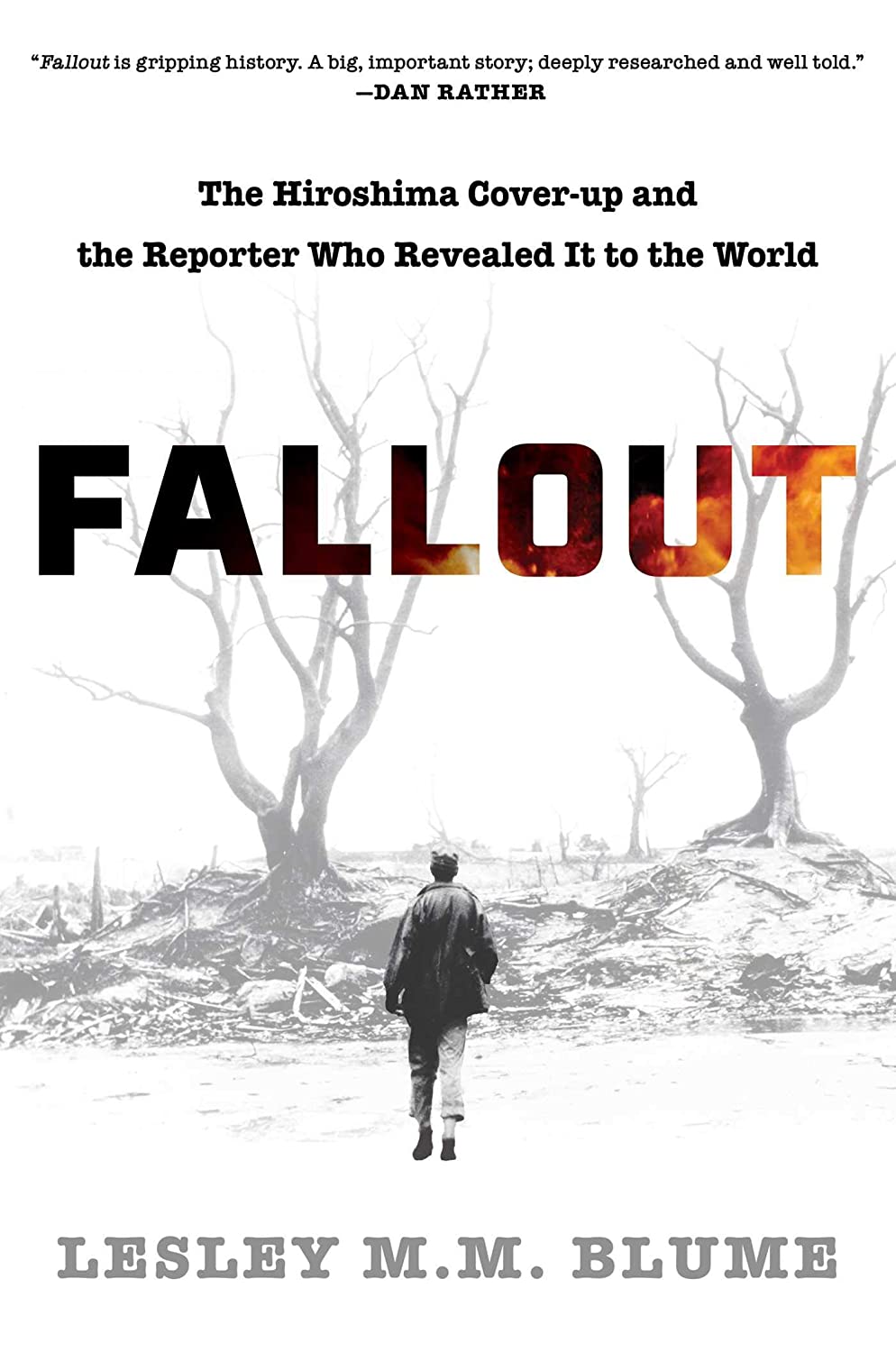
Featured New Release Of The Week: Fallout by Lesley MM Blume

This week we’re looking back at one of the most monstrous events in human history. This week we’re looking back on the nuclear bombing of Hiroshima, Japan, on its 75th anniversary through the lens of Fallout by Lesley MM Blume.

Fallout is not the story of the Hiroshima bombing, but of the coverup of its true horrific effects – and one man’s efforts to uncover them. Fallout is the story of the expose Hiroshima, written by John Hersey and published in The New Yorker on August 31, 1946. As Fallout cites the essay heavily while telling the story of how it came to be, and since The New Yorker’s website currently has the essay free to view at least as of the writing of this post in late June 2020, I very much recommend you take a moment to go read the original essay. It really is as powerful as Blume describes, and truly deserves its story being told.

Blume does the singular most remarkable job I’ve ever seen in a nonfiction book in at least one way: Nearly 40% of the text of the ARC I read of this book was bibliography. In my experience, a seemingly comprehensive bibliography averages closer to 25% to 33% of the text of a nonfiction book. Though at least in my ARC edition, the notes were not referenced in the actual text. It is unknown at this time if that was intentional or if that will be fixed prior to publication, but the effect was that it made the story flow much easier without the constant footnote references, so perhaps it is a great thing that they were listed but not directly referenced.

Blume also has a knack for the narrative, and does a remarkable job of keeping what could be a dense and complicated issue taut yet crystalline. Reading this book really gives the sense of being there and searching for the truth, yet also having the hindsight to know which passages and influences will ultimately bare out in the annals of history. Her passion for this particular essay, the history of it, and the history it describes, becomes abundantly clear almost from the first words of this effort.

Hiroshima was an absolutely critical essay for every American to read, understand, and internalize, and Blume’s work here detailing the history of how it came to be should be read right alongside Hersey’s original essay. Very much recommended.

And as always, the Goodreads review:
Continue reading “Featured New Release Of The Week: Fallout by Lesley MM Blume”